 David Yates.
Disclosure: I received a free review copy of this game from the developer.
Regular readers of this blog will know that I am a big fan of point-and-click adventure games, to the point where the genre comprises the majority of my game review output on this website – the overwhelming majority, if we’re willing to define the genre broadly. I’ve played a lot of adventure games, from LucasArts classics to the freeware AGS titles to modern commercial productions, and it’s a form that’s dear to my heart. Over the decades since its commercial heyday, many critics have needled it for what they consider fundamental flaws – linearity, ludonarrative dissonance, fundamentally static game worlds, etcetera.
I don’t share all those opinions or consider all those things flaws per se, but that does not mean I have endless patience for the genre’s foibles. Many qualities common to adventure games are necessary elements of the form, but others can rightly be considered failings and relics. The subject of this review, Swedish game studio Sparrowland’s debut The Tragedy at Deer Creek, is, unfortunately, a showcase of several adventure genre failings.
But first, the positives:
- The game’s pixel-jagged 3D graphical style is beautiful. Locations are lovingly rendered, and the game contains numerous well-animated cutscenes.
- The music and sound design are highly atmospheric and perfectly fit the visuals.
- The game is fully voiced, and the main character’s actress delivers every line perfectly.
- I enjoyed some of the more elaborate tactile puzzles – the tonewheel stands out as a personal highlight.
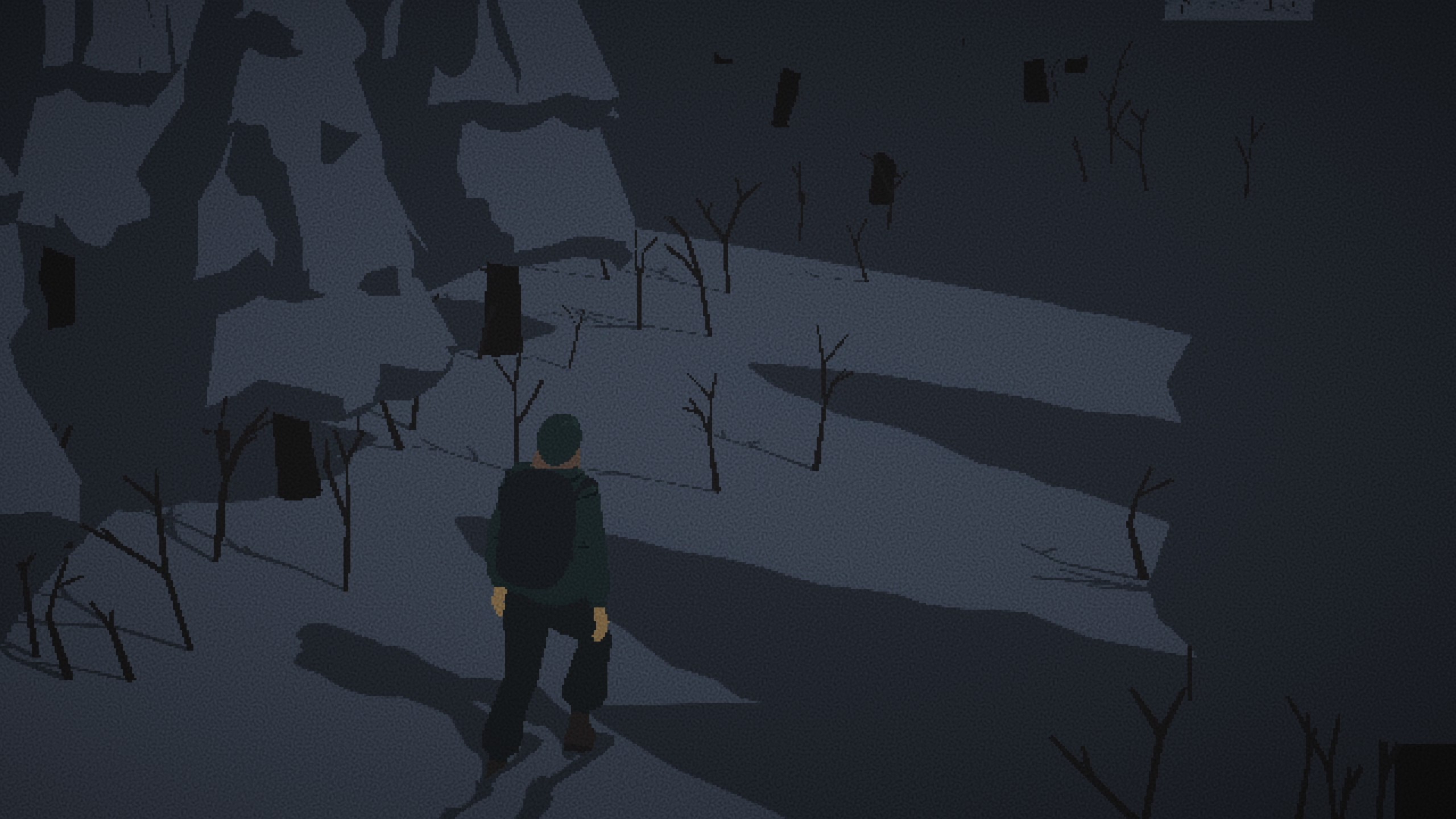
I can just about feel the chill of this snow-blanketed landscape coming off my screen.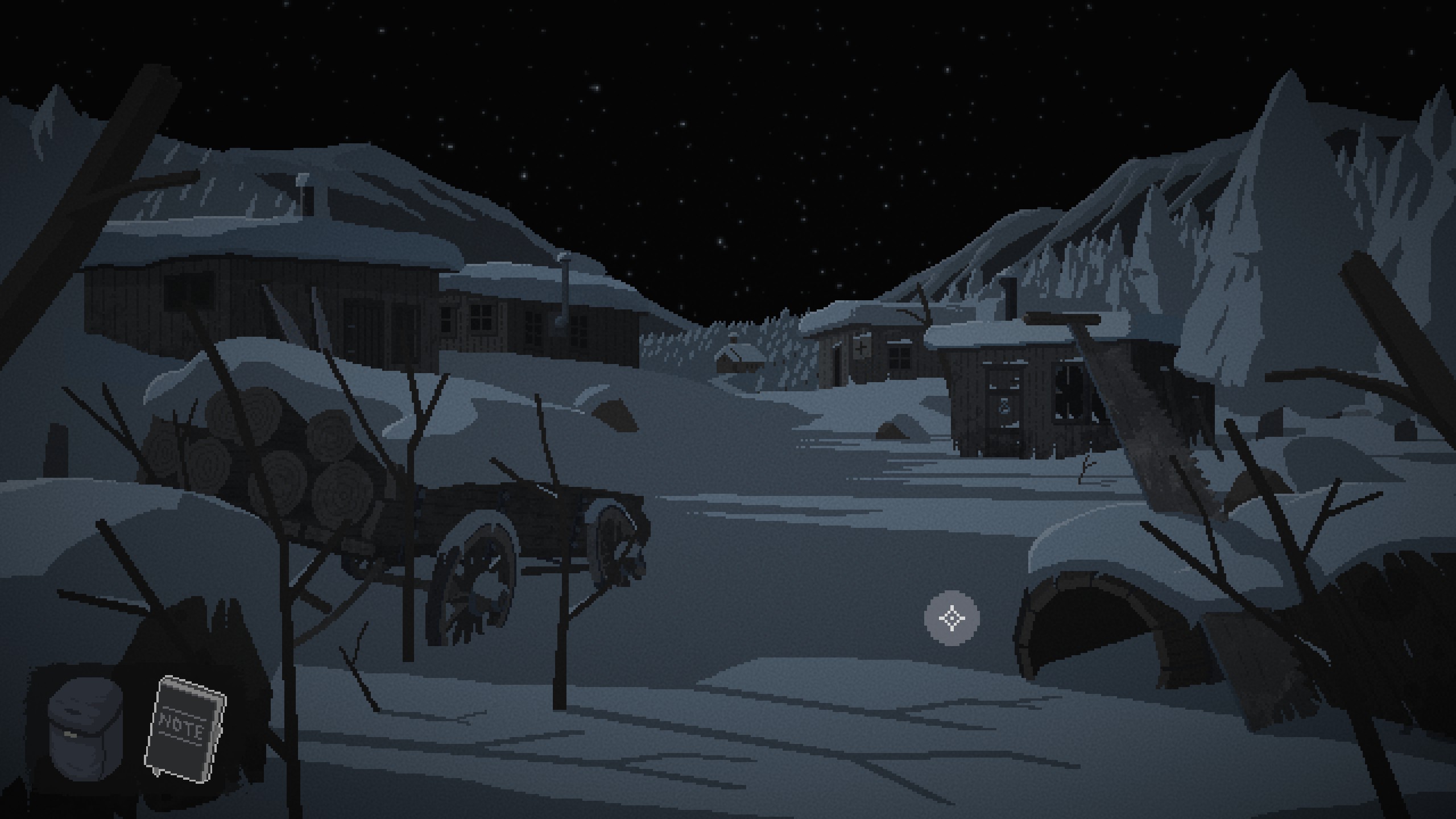
All that said, I found the game to be a highly flawed experience overall, due to both a mismatch between gameplay and story and various shortcomings of the story itself.
# Ludonarrative dissonance
This is a fancy term for the tension between story and gameplay, which there always is in a game with sufficient amounts of both. In the adventure game genre, this often manifests as games that feel like movies, which pause arbitrarily, forcing you to hunt through scenery for objects to rub together so you can solve a moon-logic puzzle before you can see what happens next.
Critics of the genre will insist that this sort of thing is inescapable, but I beg to differ. A good adventure game fits its puzzles to the protagonist’s actual role – for example, a good detective game should involve interviewing subjects and constructing hypotheses, rather than doing fetch quests to bribe guards to open doors. Puzzles can and should be constructed in such a way that they organically progress the story and/or reveal interesting details about the world.
The Tragedy at Deer Creek is a story about discovering the tragic history of an Alaskan logging camp abandoned in the late 19th century and preserved by its remoteness and the cold weather. The game asks you to comb through the abandoned locations, looking at old photographs and reading journals. This has always been a very popular way of telling stories in games because it allows for the construction of a traditional, linear narrative with characters and plot twists that do not have to account for the inherent unpredictability of the player’s actions, or provide players with even the illusion of influence over the story’s outcome. Rather, interactivity can take the form of discovering the story, piece by piece, by exploring the environment, manipulating it, and/or shooting enemies. All of these things lend themselves much more easily to melding a satisfying story with satisfying gameplay than having the player actually participate in the drama.
There are many ways to make this kind of gameplay satisfying and rewarding – the purest example I can think of is Her Story, which engages the player with the discovery of a linear story through the simple mechanic of searching a database for dialogue in video fragments. Similarly, the walking simulator1 What Remains of Edith Finch has the player explore a large, now-abandoned house, learning about its inhabitants through exploration of their preserved bedrooms.
Going into Deer Creek, I expected something similar to Edith Finch, but while the story is focused on the characters and happenings at Deer Creek all those years ago, the gameplay seems more interested in being Myst. All of the most elaborate puzzles involve assembling and manipulating strange mechanical contraptions – one of the achievements, “Adventure Game Logic 101”, lampshades the inclusion of that adventure game staple, the makeshift grappling hook.
We do get a neat animated sequence out of it, at least.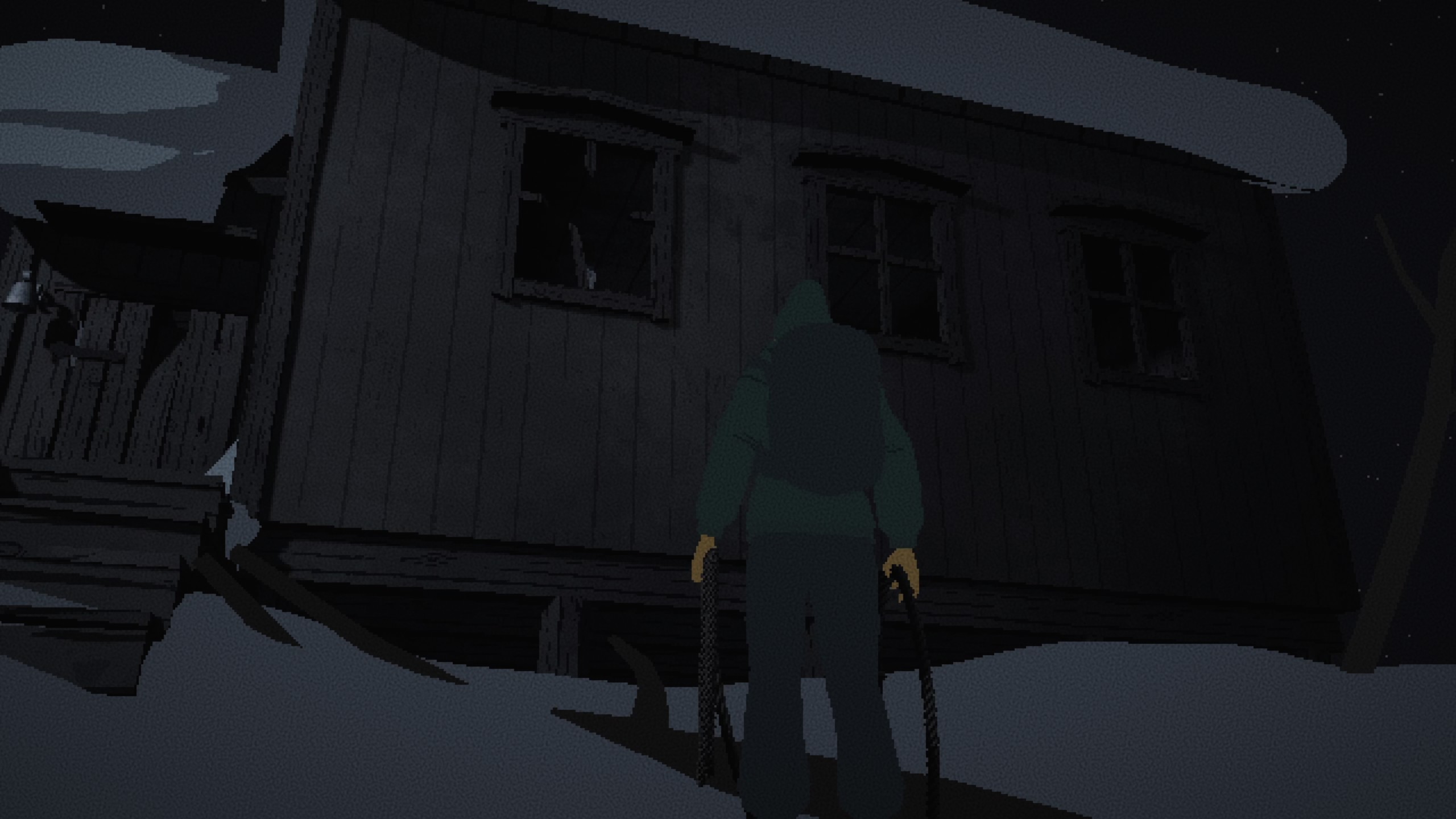
While some of these puzzles are quite fun, they seemed to me more at home in the ruins of an alien civilisation or a lost temple than a 19th-century logging camp. The logic of the story and the characters jars against them – one struggles to imagine a down-on-his-luck lumberjack building a three-piece mechanical hatch to conceal a cellar, or a morphine-addicted foreman hiding clues in the eye of a painting.
Because of this disconnect, the story feels like an afterthought, its parts scattered through the puzzles with little concern for pacing or any interesting order to the revelation of details. I found myself frustrated when a given puzzle would uncover a journal or diary with a few terse, mostly prosaic entries by one of the characters about the others. Despite being clearly the whole point of the game, the information in these documents was rarely useful for solving further puzzles, and so each time a new part of the story was uncovered, it was accompanied by the feeling of being at a dead-end rather than one of progress in unravelling the mystery. Though the game includes a quest log in the form of Charlotte’s journal, there were still times I found myself ambling around, doing things without really knowing why I was doing them.
I solved 90% of this puzzle by mistake, long before it became relevant.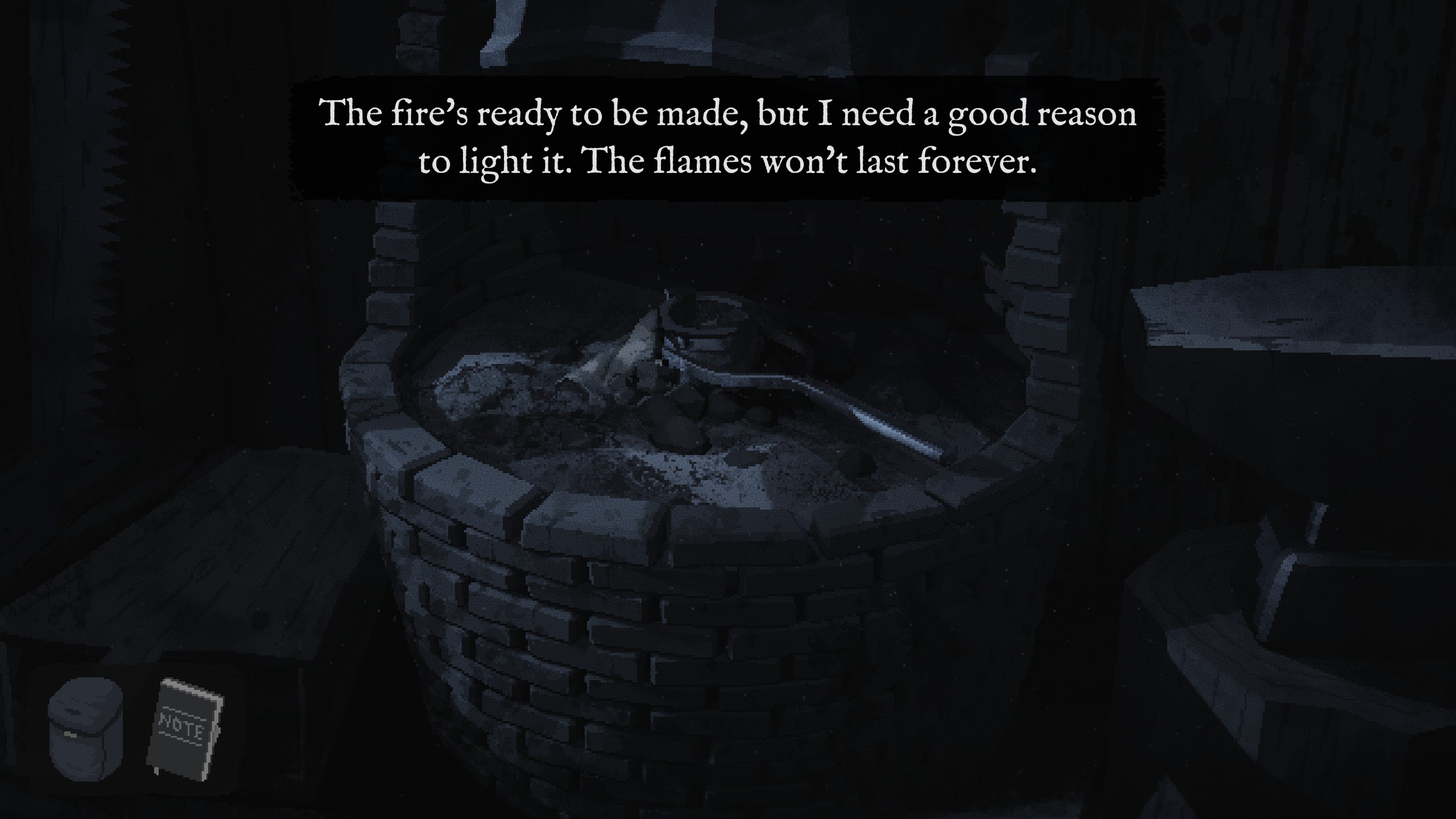
Deer Creek lacks confidence in its interactivity as a story delivery mechanism. The most important parts of the logging camp’s history are presented in a series of cutscenes from the perspective of a historical character, bookending the game’s chapters. The first of these scenes is shown long before the player character would have any way of learning its contents.
The final part of the story, and the revelation of the titular tragedy, is shown as a series of wordless slides on a magic lantern, a final reward for solving the final puzzle. There is no in-universe explanation for how these slides came to exist, though by this point the story’s supernatural elements had become largely unambiguous. This slideshow is punctuated by the protagonist’s gasps of shock and horror, which felt to me like a cheap attempt to elicit emotion from the player. But because I’d spent 80% of my game time up to this point solving mechanical puzzles, I had no investment in the story or characters, having been given little impetus to explore their relationships and few hints for forming my own hypotheses or even suspicions about what the tragedy actually was.
The experience left me cold.
# The story itself
Plenty of adventure games with severe ludonarrative dissonance manage nonetheless to tell amazing, memorable stories – Grim Fandango is a classic of the genre for this reason, despite its awful control scheme and numerous puzzles best experienced with a walkthrough open beside you. Had The Tragedy at Deer Creek combined the best of its puzzles with a well-paced and memorable story, the dissonance between them would perhaps be a lesser sin.
The game opens with a cutscene showing the protagonist, a photographer named Charlotte Gray, packing her bags for a journey of some kind while talking on the phone to her husband. We then skip ahead two days, and she is shown jumping out of a train into a snowy landscape and approaching an old man.
The train does at least stop before she jumps out.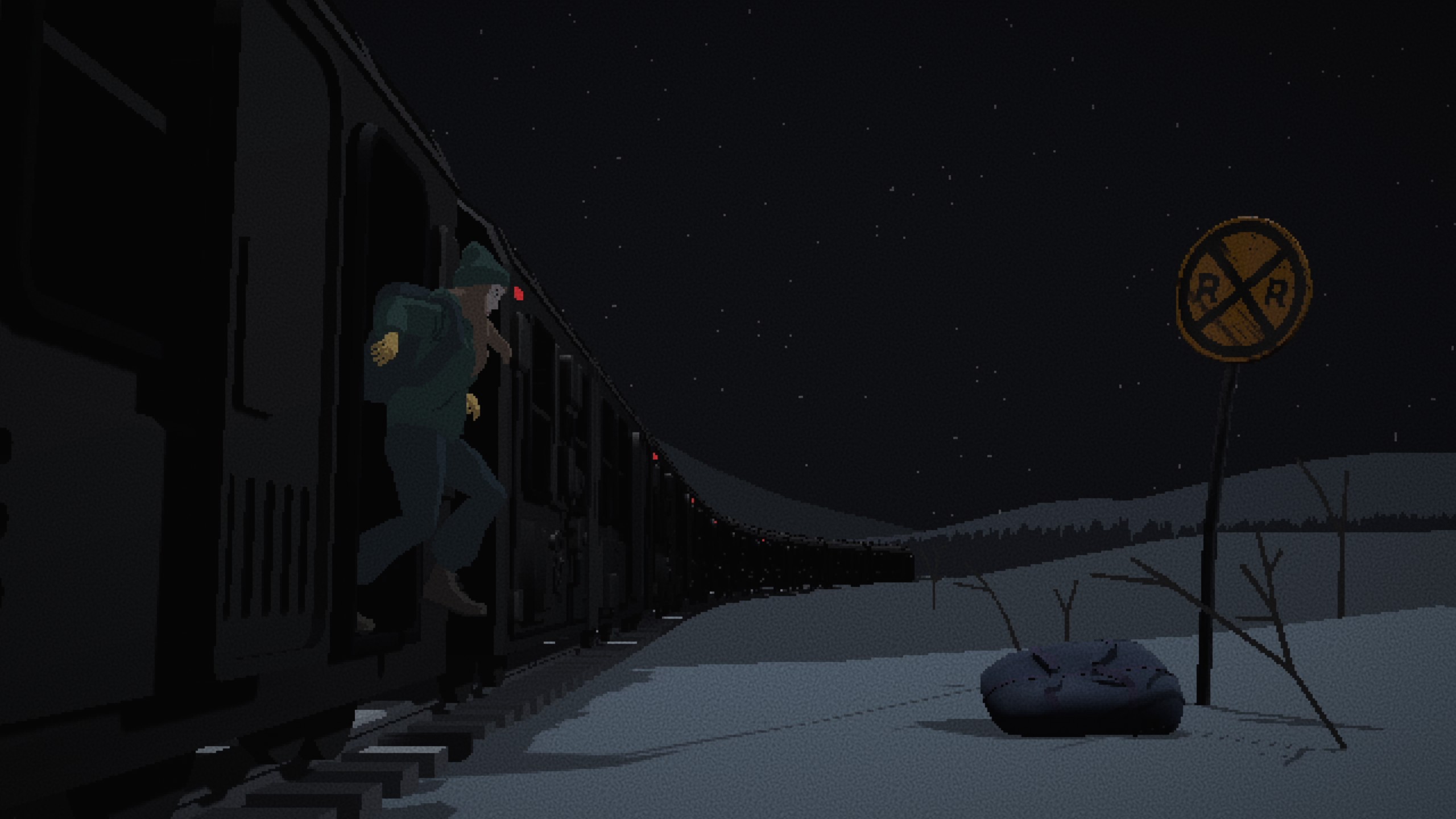
From this, I initially assumed that the game’s titular tragedy was something that had happened to her in thosewo days, causing her to jump off a train. But no, that was just part of her journey to Deer Creek. The old man leads her to a cabin and then disappears from the game. After lighting a fire, she goes out to explore the logging camp at Deer Creek.
Charlotte mentions a project a couple of times, and her initial in-game objective is to photograph every location at the Deer Creek logging camp. According to the game’s Steam page:
Photographer Charlotte Gray ventures to the long-abandoned logging camp at Deer Creek to complete her project ”Forgotten Frontiers” - a visual record of places time has slowly erased, and the quiet stories left in its wake.
This information is not provided in any obvious place in-game. Charlotte has no personal connection to the logging camp, and the game does not really characterise her strongly enough to give me a sense of what would compel her to undertake such an uncomfortable and potentially dangerous journey. There’s no mention of the broader purpose of her project, and it’s only after a mid-game revelation that she seems particularly personally interested in discovering what happened at the camp.
The story of what happened at the camp is similarly lightly sketched. We have a large cast of characters who write about each other in their journals and logbooks, and we spend the game going through their mostly preserved living spaces from 100 years ago. Individual logbook entries are terse and provide scattered details – these two characters are suspected of having an affair, these other two had a fist-fight, this one loves quoting Bible verses – but these details do not cohere into a greater narrative.
In the game’s present, spooky events slowly build to imply something supernatural going on, but if anything, these occurrences mostly provide cop-outs and easy explanations for Charlotte’s narrative – perhaps we are intended to believe that the late-game proliferation of Myst contraptions was built by ghosts.
The heart of the story is a young girl named Rosalyn, and it suffers from not truly centring her in the way that, say, the interactive fiction classic Photopia centres Alley Dawson. Charlotte has a daughter of similar age, but she’s only mentioned in the game’s opening. This seems like the obvious emotional bridge between protagonist and mystery, yet the game makes no attempt to parallel or contrast the two girls, or otherwise use this detail to deepen Charlotte’s connection to Rosalyn.
She appears on the title screen for a reason.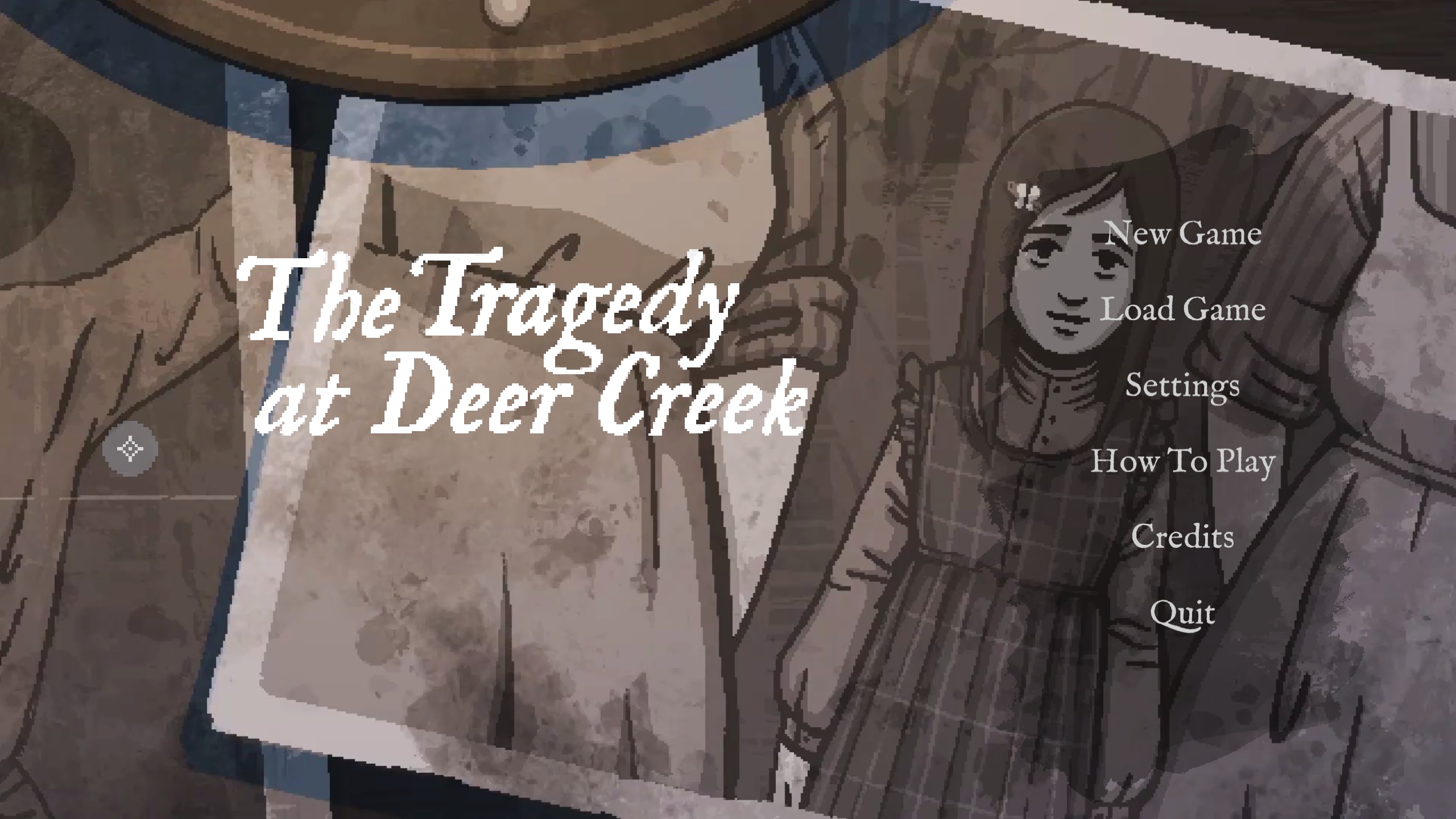
So when the mystery’s resolution arrived, I could see something of what the writers were trying to achieve, but the whole story had been so lightly sketched up to that point that it barely got a “huh” out of me. The titular tragedy of Deer Creek may be an event of great loss, matching the use of the word in colloquial speech, but it does not have the qualities of a literary tragedy, or at least these qualities do not emerge from the telling. No sickening inevitability is apparent in the conclusion – it just feels like a random act. I did not feel as though I had sufficient knowledge of the characters to divine any of their motivations.
When writing any kind of story, there’s a delicate balance between giving the audience enough material to get invested in and draw their own conclusions and interpretations from, and spelling everything out. This can be maddeningly difficult for an author, and however they choose to find that balance, there will be some audiences for whom it is either too subtle or too explicit. From my perspective, Deer Creek errs on the side of over-subtlety – I get the sense that there is a well-developed story in the writers’ minds, but the bits of it presented for me to grab onto are insufficient for real engagement.
# Unexamined examinations and pixel hunts
As I digressed about in my 2019 review of Unavowed, point-and-click adventure games have a fairly standardised set of interfaces, representing various points along the evolutionary road from the original text adventure parsers that accepted typed commands such as EXAMINE TREE and GO NORTH. In these text adventures, you’d be presented with a textual description of a room containing various items, and a large part of the gameplay would consist of examining those items, i.e., summoning up a textual description of each one (X LANTERN, X DOOR). This continued to be useful as text adventures gained low-resolution graphics, and the convention of giving each interactable item a textual description has persisted as a genre convention right up to, well, the June 2026 release of The Tragedy at Deer Creek.
The graphical capabilities of modern computers long ago reached the point where these textual descriptions are no longer necessary to fully appreciate the appearance of a given object. This is certainly true in Deer Creek, which allows you to take a closer look at just about everything but still insists on including fully voiced descriptions of each item. The in-game ability to click on a detailed picture of a hammer and hear the protagonist say “It’s a hammer” is kind of farcical at this point, a thoughtlessly repeated genre convention that has long been vestigial.2 Were Charlotte a more strongly characterised individual, or had she a personal connection to the game’s setting, these descriptions could present opportunities to explore that, but beyond a few remarks like “my grandma had one of those”, these opportunities are not taken. The game would have been better served by a single-click-to-interact-or-examine interface than the verb coin it uses.
Deer Creek also has a couple of pixel hunts, representing the only two places I got stuck in the game. One is a true pixel hunt, requiring you to spot and click on the game’s single tiniest graphical detail; the other involves a larger target, but has spiritual similarities with a pixel hunt in that you have to notice that a single object uncharacteristically has two interactable components. Needless to say, the game does not have a “highlight all hotspots” shortcut key.
Can you spot it?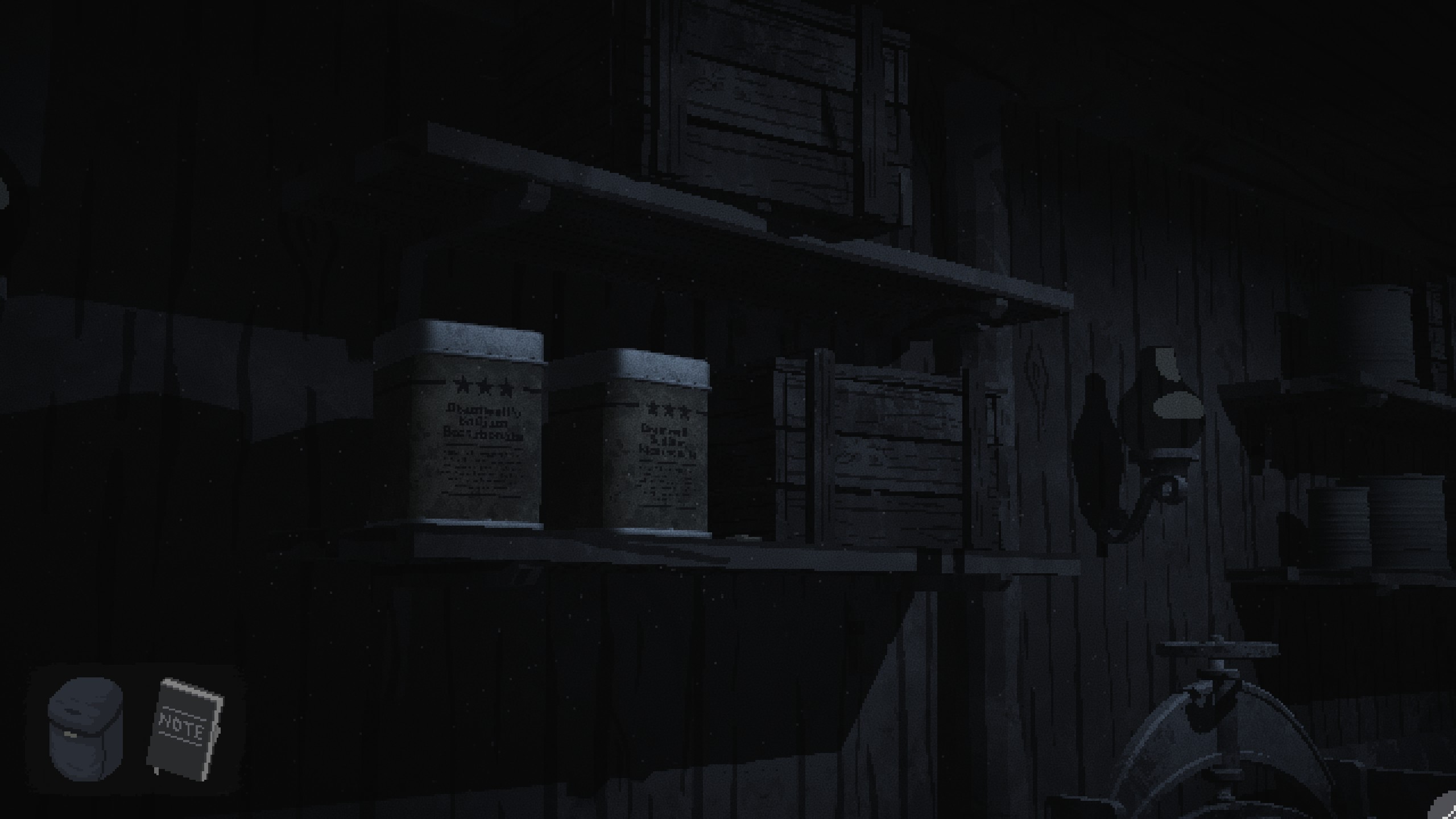
A couple more, slightly petty points:
- A little thing that annoyed me throughout the game is that just about every use of quotation marks consisted of two closing quotes. I suspected this might be a language issue – the game was developed by a Swedish studio, and, not knowing much about Swedish punctuation conventions, I imagined they might be unfamiliar with quotation marks. As it turns out, using two closing quotes is the right way to do it in Swedish. As this game’s text and voicing are in English, I will stick to this complaint. The game also uses hyphens in place of any kind of dash, and as far as I’m aware, this is not correct usage in Swedish.
- While Charlotte’s voice actress was well-suited for her role and did a great job, I was less enamoured with the voicing of Mary Adams. Some of the lines in her diary entries could have used a bit more proofreading (I was surprised that they reached the voicing stage), and she speaks with a slight accent that did not seem intentional – if it was, the game missed a good opportunity to explicitly give her character a foreign origin.
# Concluding thoughts
I wanted to like The Tragedy at Deer Creek a lot more than I did. It is audiovisually rich and has some fun puzzles, but does not provide an experience that engages you with the narrative, or present a narrative that earns engagement. At 3–4 hours of playtime, it’s not a major time commitment, but unless you really like the graphics in the screenshots above and/or really enjoy adventure-game puzzles for their own sake, I can’t recommend it. If you’re unfamiliar with any of the games I mentioned as points of comparison, I’d sooner point you toward those.
Nonetheless, I’m interested to see what Sparrowland does next. They clearly have a talent and flair for the cinematic, which I’d like to see matched with a stronger literary foundation. I think they have all of the necessary ingredients to produce a highly enjoyable adventure game if they take the right lessons from this one.
Onward and upward…